ITS WORSE: AMERICA’S WARMONGERING IN JESUS’ NAME
My name is Austin Reams. Twenty years ago I published The Morning Tree.
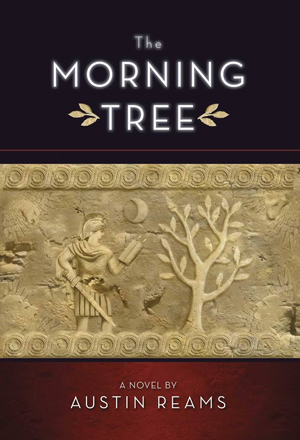
the morning tree
A historical novel written, in part, in response to President George W. Bush’s Christian war on non-Christians.
In the name of the so-called “war on terror”, ive days after the events of September 11
President Bush called for a “crusade … on terrorism…”
He said, “We will rid the world of the evil-doers. We will call together freedom loving people to fight terrorism.”
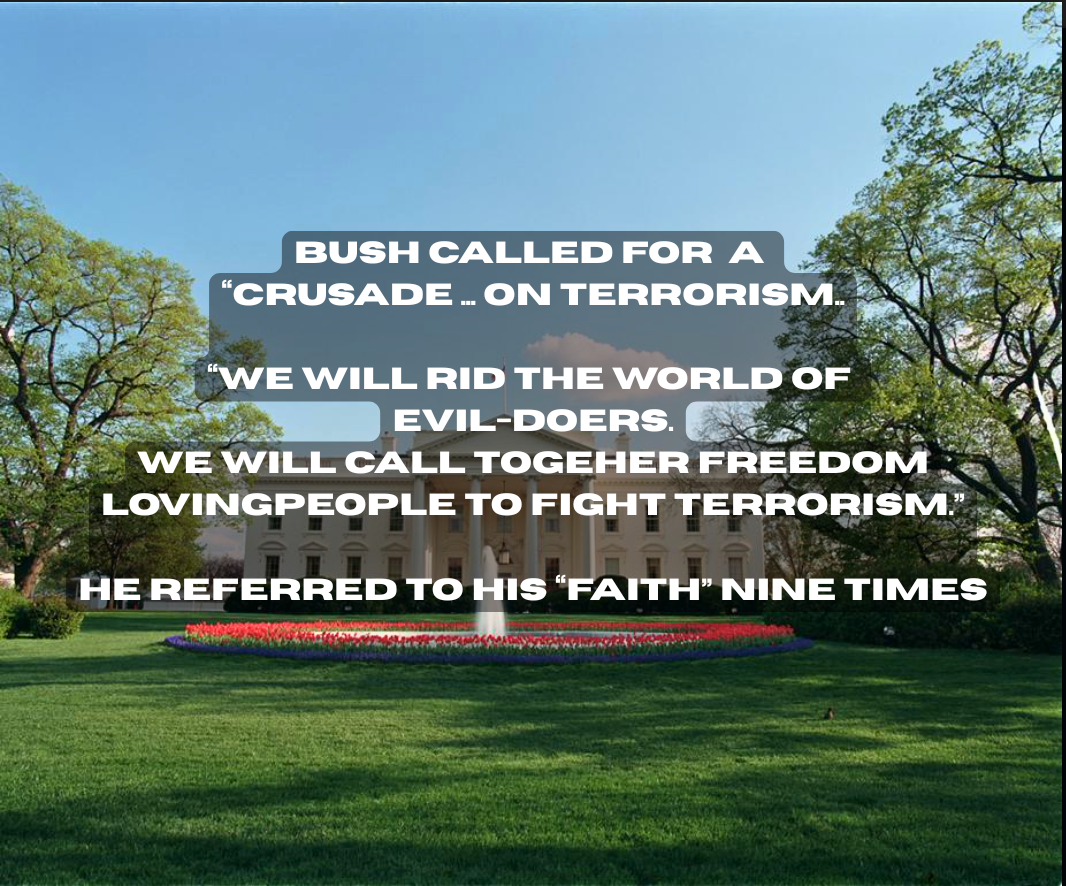 In the same speech, he reiterated his “faith” and prayers.
On March 19, 2003, when addressing the nation from the White House, telling the world that the U.S. was invading Iraq, Bush said he prayed for the U.S. Troops, ending with a prayer, “May God bless our country and all who defend her.”
His message: “It’s okay, Jesus told me its okay to go to war.”
Bush’s believe that he was something of a messiah himself was later confirmed by the declassification of British reports.
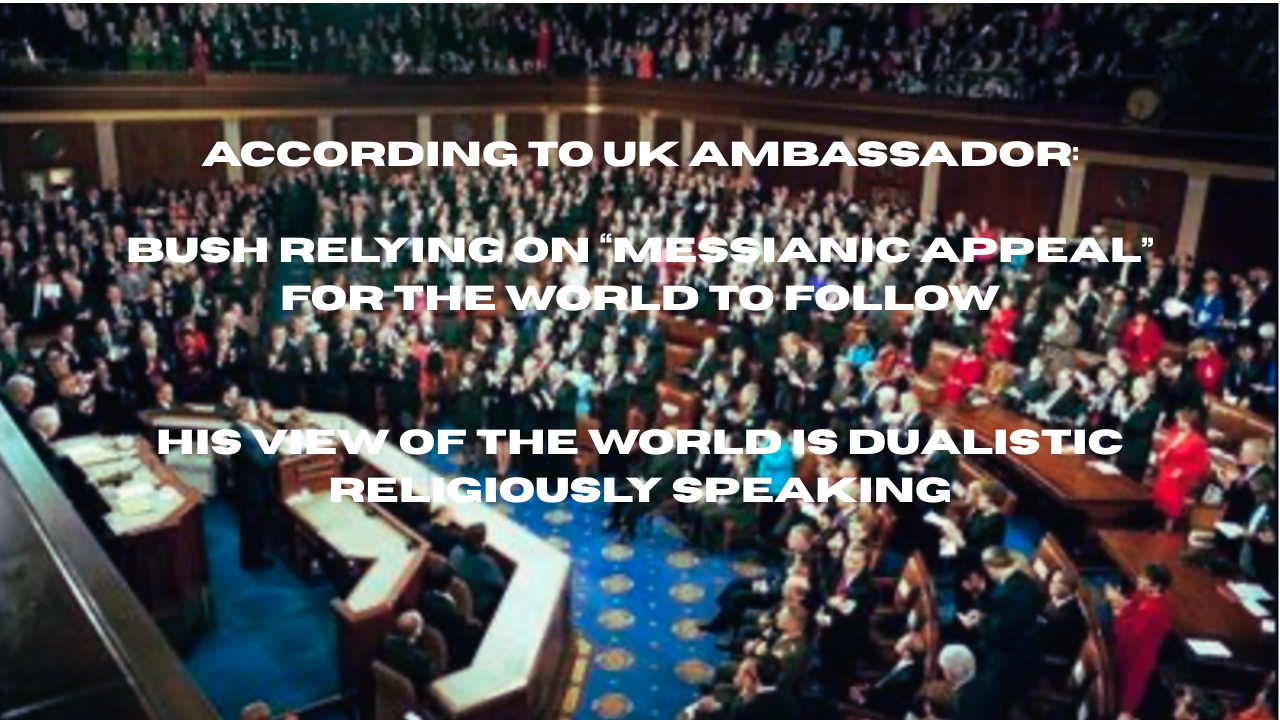 The U.K.’s ambassador to the U.S. Christopher Meyer, wrote that Bush was relying on a “messianic appeal” to the world to follow.
“His view of the world is Manichean,” apparently meaning dualistic religiously speaking.
Bush “sees his mission as ridding it of evil-doers. He believes American values should be universal values.”
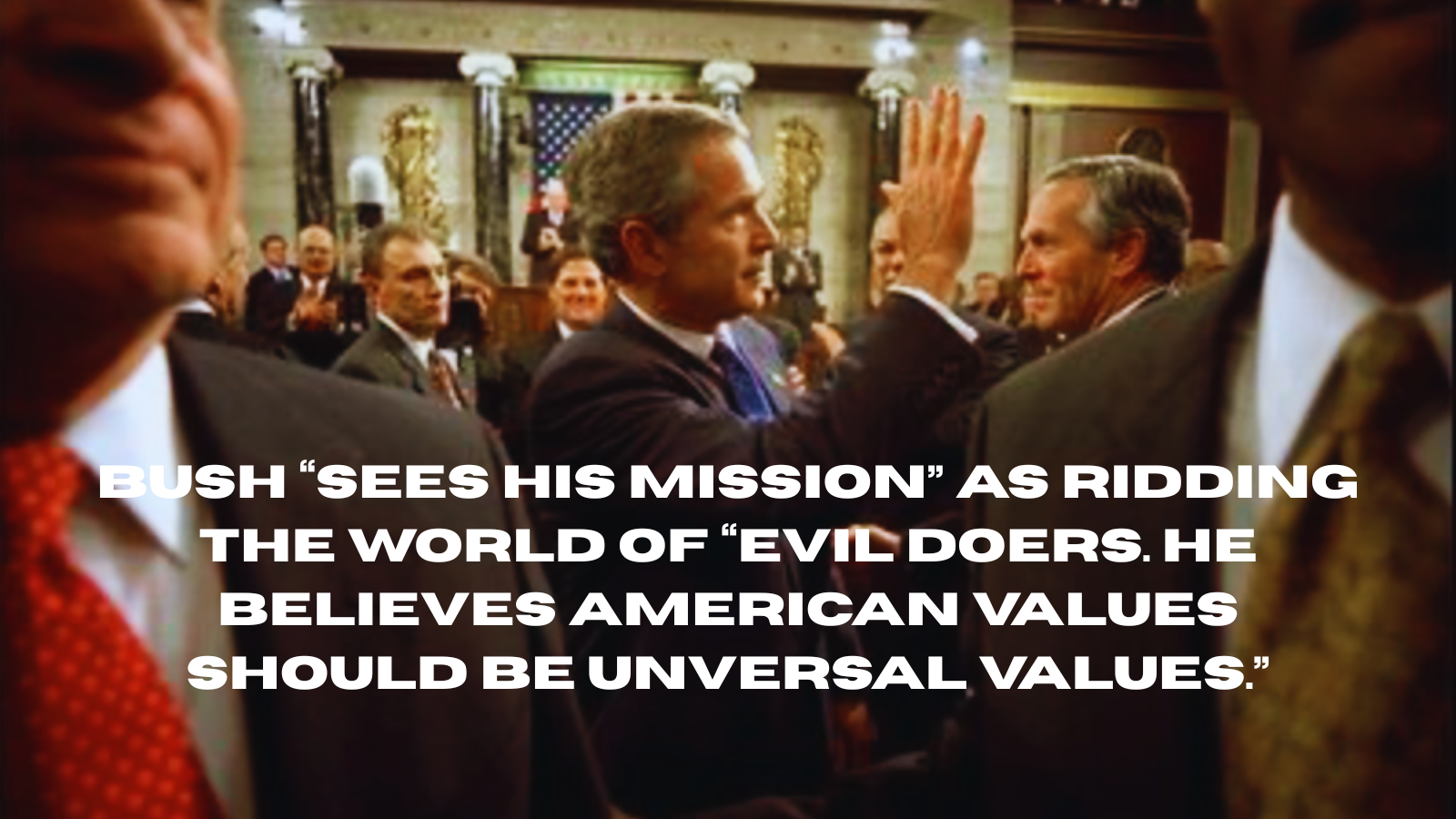
Meyers described Bush’s State of the Union address before invading Iraq:
“He said in effect that destroying Saddam is a crusade against evil to be undertaken by God’s chosen nation: ‘this call of history has come to the right people.’”

Bush was ostensibly speaking to the world as a man of Christian faith.
The Morning Tree was written in part to respond to this misconceived notion that the teachings of Jesus condone violence in any way.
The literal image of Bush telling the public from the White House, that he prayed while giving orders to go to war against the “evid-doer,” voked an image of Bush, alone in the White House chapel, hearing a voice that said he should “bring peace to the middle east,”
The solution: punish the “evil-doer.”
The thing is, Bush’s message and actions cannot be reconciled, with the teachings of Jesus of Nazareth, who said
“Do not resist the evildoer.”
Not only did Jesus say “turn the other cheek,” but also,
“Love your enemies and pray for those who persecute you.”
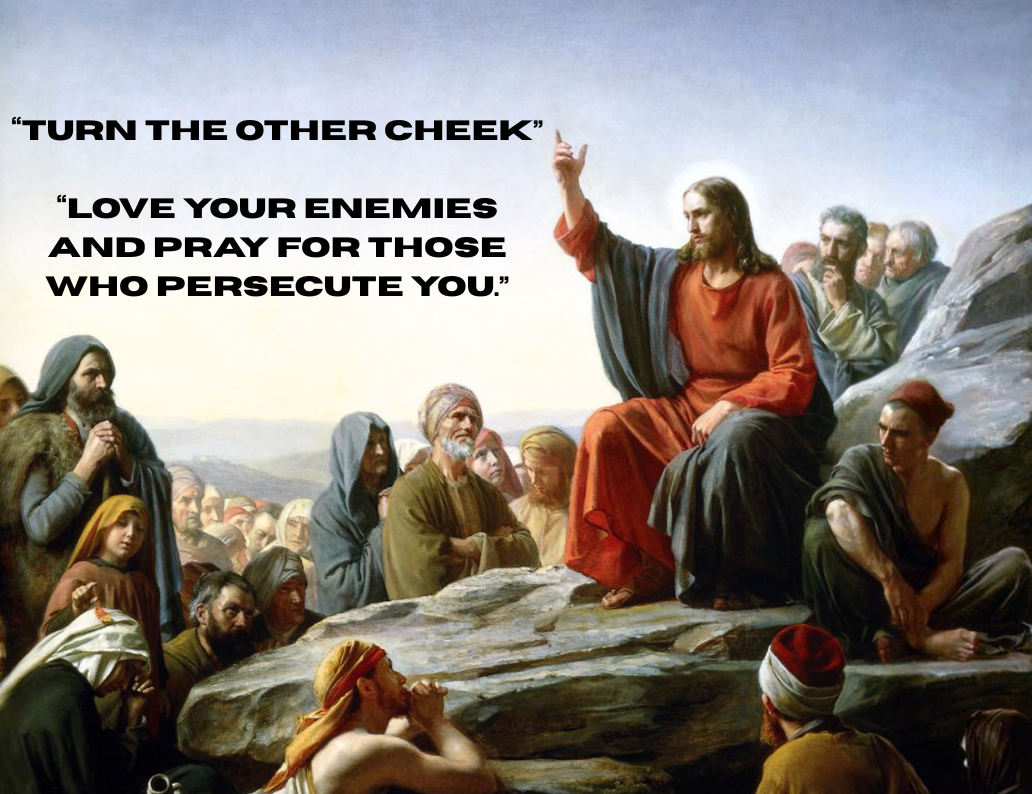
Jesus said, “[D]o good to those who hate you, bless those who curse you, pray for those who abuse you.”
There is no room for war or killing in Jesus’ teaching.
And here were are, twenty years later, and the rehetoric of hate and violence in the name of Jesus, coming from U.S. leaders
Is WORSE.
Under Pete Hegseth, Donald Trump’s Seceretary of the Department of War, reportedly hosts worship serves for employees.

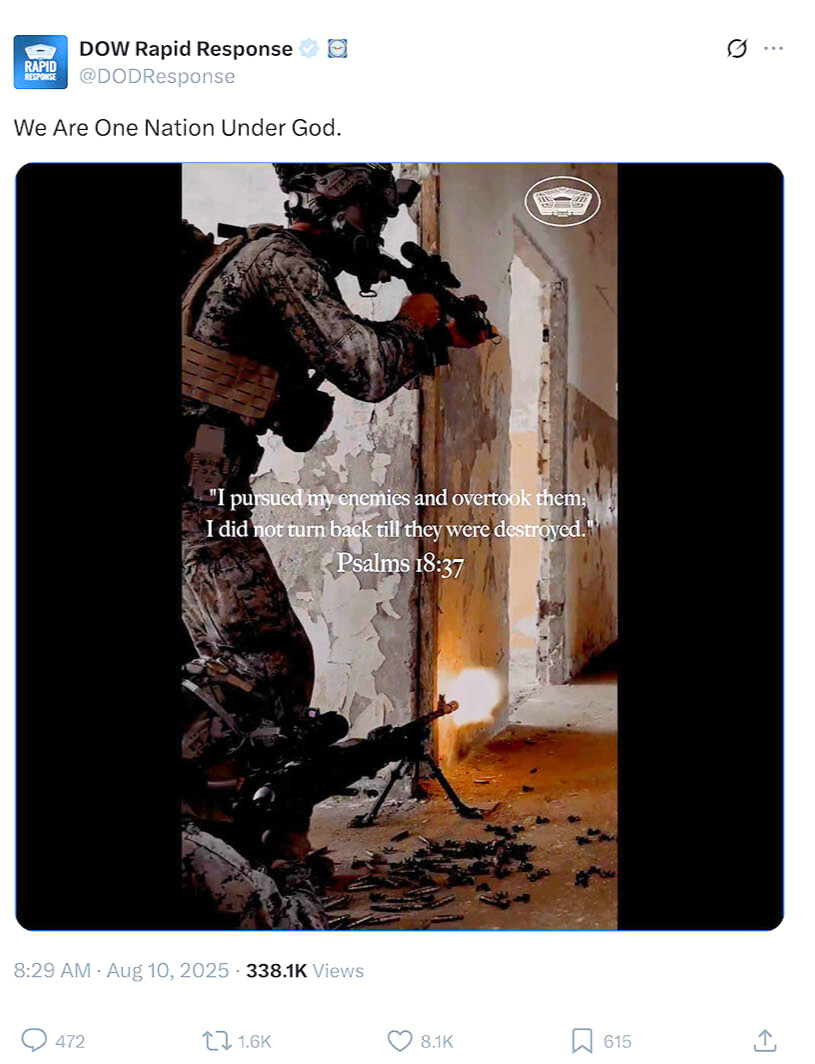
Promotional material for the Department of War quote Biblical verses:
Including:
Psalms 18:37
“I pursued may enemes and overtook them: I did not turn back till they were destroyed.”
Joshua 1:9
“Be strong and of good courage. Do not be afraid, nor dismayed. For the Lord your God is with you Wherever you go.”
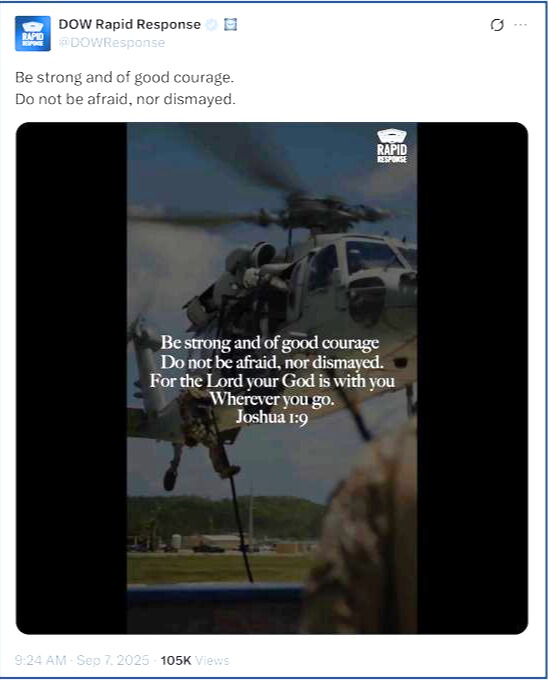
On March 20, 2026, Gegseth gave a speech at the Petagon, invoking Biblical verse to justify the war on Iran:
Quoting Palms 144 “Blessed be the Lord, my rock, who trains my hands for war and my fingers for battle.”

Regarding America’s unprovoked war on Iran: His message to the world, the middle east, “ungreatful allies,” and segments of the press, everyone should say “thank you” to President Trump.

Such is consistent with Hegseth’s 2020 book, American Crusade, n which he wrote, “thank a crusader,”

Using imagery which is similar to Nazi propaganda:

Gegseth reportedly has tattoos, including one from crusader imagery,

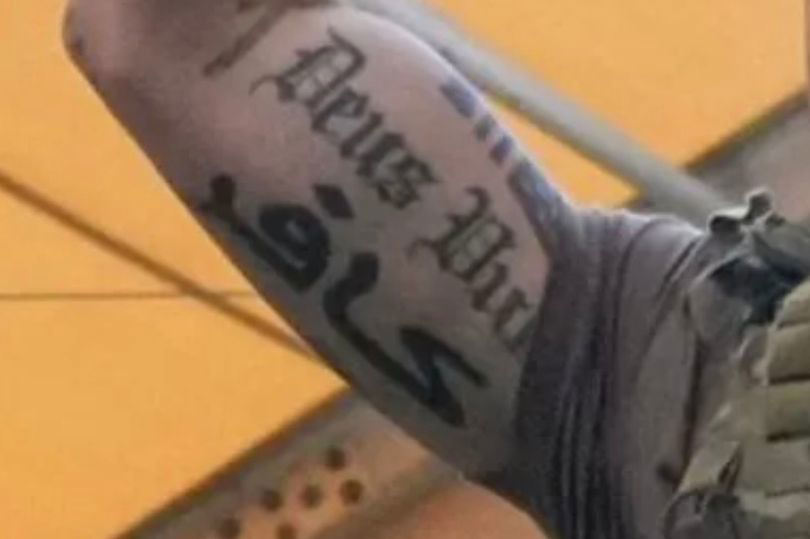
With a Jerusalem Cross and the phrase “Deus Vult,” – God wills it
Which Hegseth has reportedly called “the rallying cray of Christian knights as they marched toward Jerusalem.”
Regarding whether Hegseth views the war against Iran in religeous terms, the Department of War spokesperson referred the press to a CBS interview
“We’re fighting religious fanatics who seek a nuclear capability in order for some religious Armageddon,” Hegseth said of Iranian leaders. “But from my perspective, I mean, obviously I’m a man of faith who encourages our troops to lean into their faith, rely on God.”

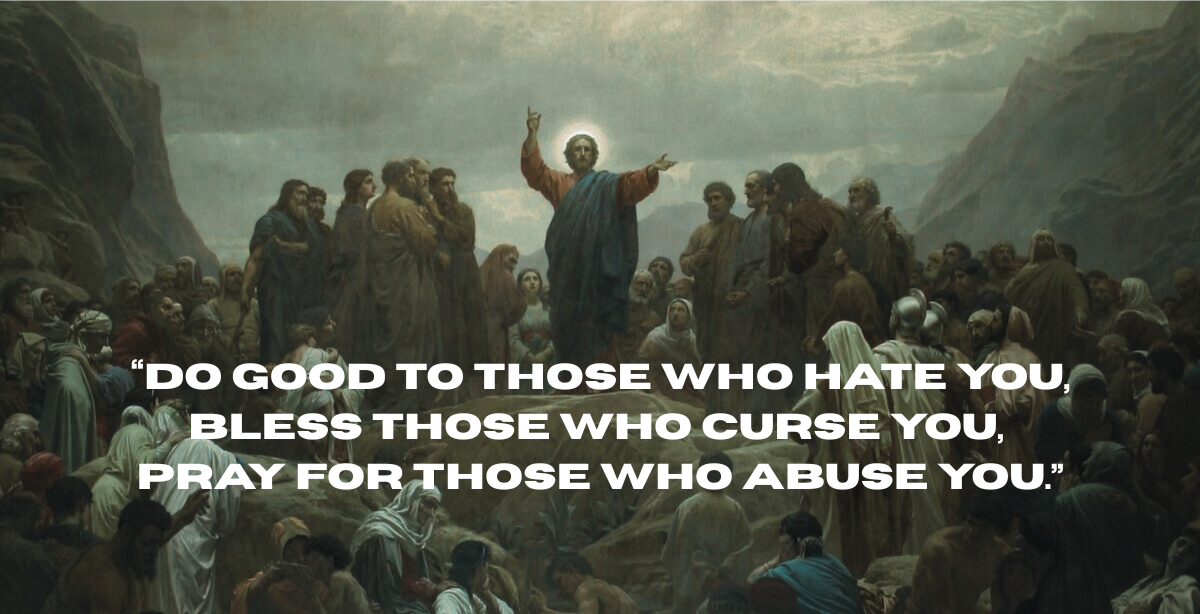
But Hegseth does not quote Jesus from the Sermon on the Mount.
For he cannot, given that Jesus condemned violence:
Saying: “[D]o good to those who hate you, bless those who curse you, pray for those who abuse you.”
It is uncanny how similar Hegseth is to Bush W. Bush exactly 20 years later.
“True believers” in Jesus, men who actually believe that Jesus has sent them into the middle east, to do “God’s will”, to punish the “evil-doer.”
Such men woefully misguided men were part of the inspiration of Ras, in The Morning Tree, a centurion who believed that Jesus had appeared to him, as an angel of light, telling him to go on a crusade, to find a Gospel written by Jesus himself, the missing gosepel has been stolen by a rogue Disciple Nathanael.
Being a military man, Ras uses violence in his crusade to find the Gospel.
In the end Ras finds that he has been deceived.
People were not as they seemed to be
Along the way, Ras finds himself under arrest in the catacombs under the Temple in Jerusalem, during the Festival of Weeks, after Jesus was crucified, where he find an unexpected voice.
The following is a passage from Chapter 16 of the Morning Tree (Copyright C. Austin Reams (c) 2006:
Ras kept still for a moment, waiting for the guard to leave. He quickly flung off his clothes, crouching down in defense in the nearest dark corner. He waited for his eyes to adjust to the darkness.
“You have nothing to fear from me,” said a man holding his foot in pain.
Ras inspected his surroundings, searching for any immediate threat. He was in a dark jail cell, which was little more than a small niche built into the damp wall of a long passageway, masterfully constructed with rough stones. Large rectangular stones paved the floor outside the cell. Heavy beams of wood, crisscrossed against each other, were set into the wall surrounding the entrance to the cell, preventing escape. A mechanism far down the passageway, out of their sight, released the lock to the entrance of the cell. A few paces across the passageway from the cell, a torch burned, giving barely enough light to see.
“Did they set you on fire?” said Ras’ cellmate.
Ras laughed and spoke. “No! Why would you ask that?”
The man hesitated, squinting his eyes in the dim light. “Sorry. It’s just that you’re skin looks. . . ”
“Like I’ve been burned,” said Ras. “No, I’ve not been burned.”
“What did they arrest you for? What did you do wrong? Did you fight back? Where are you from?”
“You ask too many questions.”
“I’ve been alone in here for what must be several moons. No one to talk to.”
Ras nodded. He took off his other garments and threw them into the corner.
“You’re a soldier!. Are you Roman? Do you know Pilate?”
Ras looked at the man with hot eyes.
“Sorry, but you’re wearing a soldier’s kilt under all that garb.”
Ras leaned his head against the raw cut beams of the cell entrance. I’ve failed you, Jesus. I never came close to finding Nathanael. Many are called, but few are chosen. That’s what you said. Maybe I was not chosen. I’m a mere thief caught in a lie in God’s house.
He sat carelessly on the ground. The man next to him continued to talk and ask questions. Ras ignored him. How did this man get thrown in jail? Too nice, and smiles all the time. That kind of man would never say a cross word to anyone, Ras was sure about that. It was easy to be mean to that kind of person. Most would feel guilty later. He would die a horrible death like Ras. No matter what such a babbling fool did wrong, though, he would not deserve the punishment that was surely coming. Ras listened to the stranger’s droning voice, then suddenly felt deep pity. He sounded like a young boy, trying to pretend that he was not homesick. “Mommy,” was on the tip of every word.
“Why are you in here?” said Ras, letting the words out slowly, knowing he was opening a floodwater of conversation.
“Blasphemy,” said the man. “Same as you.”
Ras waited for more. But the man said nothing else.
“Blasphemy? That’s it?” said Ras.
The man shrugged, rolling his eyes as though he was thinking about another subject to talk about.
“What did you do, say that Caesar was more handsome than Caiaphas?” Ras gave a hearty laugh.
The man shook his head.
Ras sat up, leaning over his knees. “Well? What then?”
“Blasphemy against God’s temple.”
“What did you say?
The man looked through the beams of the cell, checking to make sure no one was there. “I said Jesus is the Messiah and Jews need not worship God at the temple anymore.”
“And that got you arrested?”
“It got Jesus arrested, too.”
“What do you mean, you’re the one in this cell.”
“It got us both arrested.”
“Wait a minute. What’s your name?”
“Judas Iscariot.”
“Well, Judas, there’s got to be more to it than that. I’ve said Jesus is the Messiah and I’ve not been arrested for it.”
Judas gave Ras a curious look, then glanced at the wooden beams of the cell, which testified to the fact that Ras had been arrested.
“Well, all right, I’ve been arrested, but not for blasphemy,” said Ras. “I’ll say it here and now, ‘Jesus is the Messiah.’ No one is outraged because there are many other prophets out there that say they are the Messiah. Where were you when you said it?”
“With Jesus.”
Ras smiled widely. “With Jesus? You knew him?”
“Yes, of course, I was one of his disciples.”
Ras’ face went hot. Judas betrayed Jesus! He sold Jesus to the chief priests and turned the Messiah over to Pilate to be crucified. In a wave of rage, Ras rushed at Judas, taking him by the neck, throwing the traitor across the cell in an instant, smashing him against the rock wall. Judas careened off the stone surface and landed on his shoulder upside down. He tried to speak in defense, but Ras was relentless. He attacked the man again, pummeling him with his fists and then kneeing him in the gut before hurling him into the beams. The treatment was particularly brutal for Judas, a man who had never been in a fight in his life. Outside the cell and down the passageway, a couple of guards heard the commotion, and shrugged, hoping that one of the prisoners would kill off a cellmate, one less man to worry about.
Judas bled from his mouth, holding his side in agony. Nearly crying, he held out his hand to Ras, saying, “Blessed are those who are persecuted for righteousness’ sake, for theirs is the kingdom of heaven.”
Ras hesitated in his rage, his fist pulled back for another blow. “Righteous! You? Righteous? Damn you!” Ras’ fist plowed into Judas cheek, knocking him back against the opposite wall like a dead chicken.
The beating was terrible, but Judas did not beg for mercy. He continued to murmur prayers, shivering with pain. He held out his hand again, and said, “Blessed are you when people revile you and persecute you and utter all kinds of evil against you falsely on my account.” Blood bubbled at the sides of his mouth, slurring his speech.
Anger swelled in Ras. “You are the liar here, demon!”
Ras stomped him in the gut with his hobnailed sandals. Judas gasped for air, rolling over on the floor. Judas tried desperately to catch his breath. He coughed heavily, and said quietly into the ground, “Blessed are the peacemakers, for they will be called children of God.” Ras finally listened to the words. Judas was not begging for mercy. I love it when people beg, thought Ras, surprised at his own mercilessness. Brutalizing victims had once made him feel powerful, respected. But suddenly, in the cave, where no one else could see, Ras did not feel mighty or powerful. He felt shame.
END OF PASSAGE
Such was forshadowing for the same to come. For the violent atrocities the US has done in, Iraq and Afghanistan, and more recently n Gaza, Lebanon and Iran, in the name of Jesus, has been in SHAME.
In the Morning Tree (Copyright Austin Reams (c) 2006), the result of such shame is revealed in Chapters 20 and 21. In these passages, Ras, the centurion, has been on a quest to find the lost gospel written by Jesus himself. He believes that he has finally found this disciple, Nathanael, and being a man of war, believing he has been set on a mission to punish the ‘evil doer’ in the name of Jesus, he exacts his will in the form of violence:
CHAPTER 20:
His last chance to do God’s will had finally presented itself. Ras rushed out from behind the tree, his sword raised high over his head, ready to stab downward into whoever stood in his way. He pulled the full force of his weight into the blow, which struck deep into the man standing before him. The stranger fell to his knees under the tree and Ras pressed on the sword with both hands, pushing the sword in as deeply as he could. He jammed the blade down into the man’s chest, the hilt stopping in front of his face. Both of Ras’ hands were clasped on the hilt. When it stopped, Ras was face to face with his victim.
There was no cry of pain or suffering from the man. Ras opened his blurry eyes and looked into the face of the dark-skinned stranger who had threatened him at the Sychar well.
Ras stood to his feet quickly. The sun scorched his skin but he not notice. “You!” he said. Nathanael had been within my grasp. The man softly held one hand at his chest, touching the hilt of the sword. Instead of crying in agony, he smiled at Ras. Spit and blood ran from the outer edges of his mouth and down his shoulder. Then he dropped an object he had been carrying under the other arm. The scroll of Jesus fell to the ground with a bounce, rolling down the hill. The man caught the edge, allowing the scroll to roll away from the tree. A long bloody page of Jesus’ teachings opened to the orange glow of the morning sun.
“It is you!” said Ras. “Nathanael!” Still in a fury, and ignoring the burning pain of his skin, he pushed the sword once more into the man’s chest, and then kicked him to the ground. The man fell, pouring blood onto the open scroll. He coughed, trying to get up on one hand. Ras stepped over him, put his heel on the man’s neck, and rubbed his face into the scroll of the Messiah, forcing him to breathe his last onto the written words.
“You thought you could get away with those lies!” said Ras.
He took the man by the back of his neck, and yanked him up toward the tree, pulling the sword out of his chest, tossing blood around the base of the trunk. Ras leaned him up against the tree, saying, “This is payment for your sins!” He thrust the sword through the man’s chest once more. The blade sliced clean through him, exiting his back and burying its point in the fig tree.
The man was still smiling, despite the pain. He coughed on his own blood and looked at Ras with calm eyes of pity. The man’s expression was much too peaceful for one taking his last gasp of breath. The man motioned for Ras to come closer. Ras stepped over, kneeling down next to the man, who looked deeply into his eyes.
The man said, “I forgive you,” and then he let the last breath out, and died.
The eagle screamed from above. Ras turned with his arm raised, expecting to be attacked, but he only found clear blue sky.
Ras blinked heavily. He could see clearly, though the sun had risen. He looked at his raised arm, now illuminated in direct sunlight. His skin did not peel from the blistering rays. His skin was smooth, without blemishes. The sores had disappeared. Ras rolled his head back, allowing the sunlight to warm his chest and neck, with arms wide open. His sickness was cured. I accomplished the mission Jesus asked me to do, and this is my reward. “Praise God!” he said, shouting to the sky.
He looked back down at the bloody mess of the man. Ras laughed. “I forgive you, too!”
A gust of wind caught the scroll and started to carry it away. Ras caught it, and rolled it up tightly. Baal wandered to the top of the hill next the tree, looking down at the stranger’s body. “Normally, I’d punish you,” said Ras, “but under the circumstances, I’ll let you slide this time.” He secured the scroll into a pack that was strapped to Baal’s back, unwrapped the bandages from his hands, and combed his fingers through the horse’s black mane.
Ras leaned over the dead man, grabbed the hilt of the sword, and pulled. It did not move. He put his foot into the man’s chest, pulling harder, but he still could not free the sword. After several unsuccessful attempts, he gave up. He had achieved his goal. The only task left was to return the scroll to Peter and John in Jerusalem. He had no need for the sword. He would first return to nearby Capernaum and retrieve Mark and Joseph to share the good news. He mounted Baal and rode away as quickly as he could, uneasily glancing over his shoulder at the morning tree.
END OF PASSAGE
But Ras senses that something is off. His worse fears, the realization that he has NOT acted according to the teachings of Jesus, comes to him in horror. He has been acting in the name of evil.
BEGINNING OF PASSAGE FROM: The Morning Tree, Chapter 21 (Copyright Austin Reams (c) 2006)
When Ras reached the foot of the hillside, the sun was nearing the horizon. It would be setting soon. He stared ahead at the morning tree at the top of the distant hill. He tripped over stones and small bushes as he ran.
At last he reached the fig tree and fell to his knees. The sword’s blade remained buried deep in the trunk. Dried patches of blood lingered on the dusty ground. Despite evidence of a recent death, the body had vanished. Ras looked for a bloody trail and found nothing.
He rested one arm on the ground and held the other to his chest, clutching at his swollen neck. “No, no, no,” he said, growling softly to himself. He dug his fingers into the ground, and then leaned backward on his knees, throwing dirt helplessly into the air. “No! God! No!” he screamed at the sky, tears streaming down his face. He looked up, expecting to see God’s hand to come down from the heavens to strike him dead. He only saw thick, dark storm clouds gathering overhead.
He reached for the sword. The blade vibrated slightly with a gust of wind. He touched the hilt with his index finger. God is coming to kill me.
“He’s not coming to kill you,” said a voice.
Ras turned to find Baal, his horse, standing behind him. “Did you say something?” said Ras, disbelieving.
The outline of the horizon disappeared as the dusk darkened. A loud crack echoed over the countryside like the hammer of God. The evening fell into blackness. A perfect circle of light encircled the morning tree, setting it apart from the blackness.
“I said he’s not coming to kill you,” said the horse. “But he’s not going to do you any favors, either.” Ras watched as the horse’s body dissolve in waves of color and turned into the man that he knew as Jesus. That man was dressed in pure white robes. A crown of fig leaves with blossoms rested on his light brown hair. He leered at Ras, who heard a smoky voice in his head: You know better than that by now, don’t you?
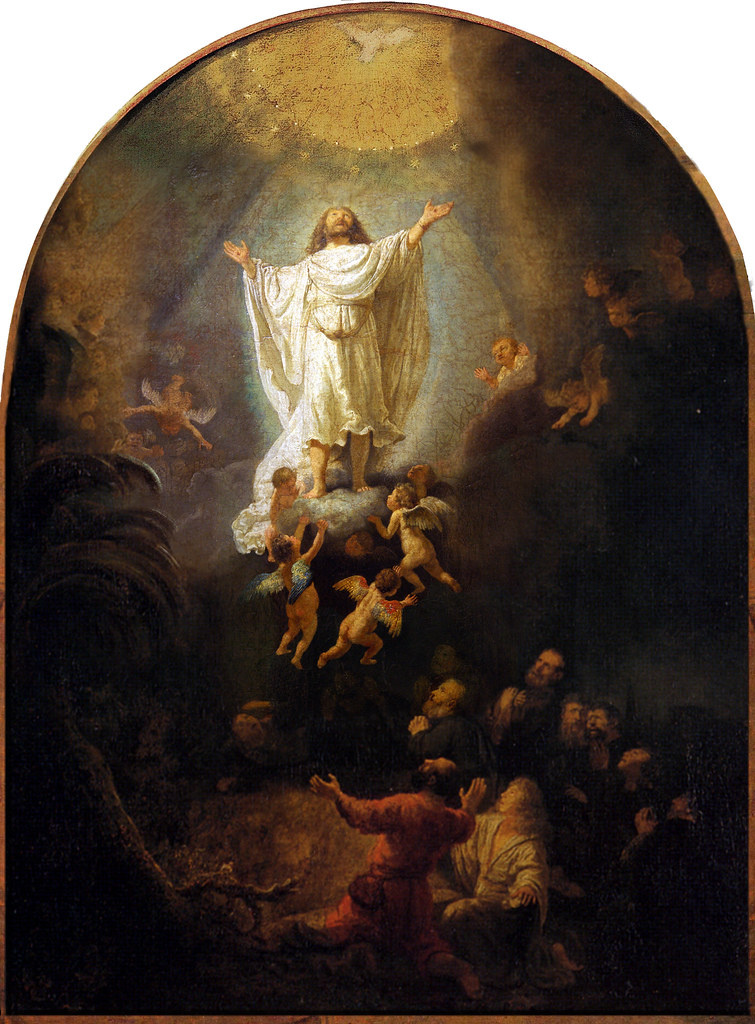
Ras pushed against his knees to stand. He remembered when the man had levitated and appeared in a flash of pure white light. Knowing what Ras expected to see, the man ascended again and wiggled his toes at the ground. A pure white light flashed behind him. “Is this what you had in mind?” said the man. But he was neither man nor angel. “Even I can disguise myself as an angel of light.” He gestured to the fig tree, covered with fresh leaves. “Didn’t you know that fig trees do not blossom?” Suddenly the crown of fig blossoms on his head turned to a wreath of thin green snakes, which fell from his head and scurried into the darkness away from the fig tree and the circle of light. The man gently shooed them away like little children.
Ras jumped to his feet, backing away.
“I won’t harm you,” said the man. “I want to find a way to reward you.” He looked at Ras from head to toe, puzzled by the fact that he had been healed.
“Get away from me, Lucifer!” said Ras. He hurried behind the tree and held the trunk with both hands. He looked behind him past the circle of light into pure darkness.
“I would not go there if I were you. At least not right away. You will not like it. I promise. But don’t take my word for it.” He smiled widely, baring his pure white teeth. “Now don’t worry. I’m here to congratulate you. I’m here to thank you. I might even reward you, if you ask for it.”
Ras fell to the ground and held his head with both hands. He shut eyes tight like a child, and prayed for the vision to leave. He opened them again.
Lucifer gave Ras a sarcastic smile. “It is not as easy as that.”
Ras curled up on his side, and sobbed for God to hear him.
“He cannot hear you.” He smiled again, showing his teeth. “Ras, you are one of my finest pieces of work. I must say, once I persuaded you, you followed through like the best servant anyone could ever want.”
“Damn you to hell, Satan,” screamed Ras.
“Yes, well, you’re behind the times, son.” Lucifer laughed at himself. “Son,” he said again. “Yes, he is like my own son.” He nodded to his left and right acknowledging an invisible audience. Crossing his arms across his chest, he sighed with satisfaction. “Splendid. All it took was for those bumbling disciples to ask you to find the scroll. After a touch of ‘divine’ encouragement, you were off on a death hunt. Splendid, indeed!”
“I never meant to kill him,” sobbed Ras.
“Yes,” Lucifer said, chuckling. “You didn’t have any problems cutting those poor pilgrims to pieces outside of Sychar. And what a fine job you did, I must say. And what about all those others, Jews and Gentiles, whom you’ve slaughtered in your career? Pilate provided you with the best training. Praise me, he did not teach you anything about politics!”
Ras reached out at the sword stuck in the tree, but he did not take hold of it. “Jesus lives!”
A guttural laugh moved up slowly from Lucifer’s chest and exited his throat, infecting the air with anger. The sound contrasted with his pure white appearance, for it was a wail of evil pleasure, the pleasure a beast takes in slaughtering the innocent. “No, I’m afraid you killed him, and good. You did it, my son. Although there were several times during your journey that I thought you might reason it out. I mean, he was dropping you hints all over the place. That’s cheating.” Lucifer shook his fist playfully at the black sky. “Jesus himself appeared to you in Sychar. You were too afraid to speak to him.” Lucifer shook his head, stroking his beautiful blonde hair with his fingers. “Fear comes in handy, if I do say so myself.” He spoke as though he had invented the concept. “It has silenced the truth time and again. And when Joanna was talking to you about what she saw that day that Jesus was supposedly crucified . . .my word! I thought you would get it for sure.”
“Get it?” said Ras.
“You still don’t understand?” Lucifer held out his arms questioningly, and then shrugged. “I’ll explain. The day Jesus was arrested the priests took him before Pilate, who disliked the priests more than he disliked Jesus. The fact that they wanted Jesus dead made him want to save Jesus.” Lucifer shook his head. “And that man is supposed to be on my side! Anyway, he had a soft spot in his heart for Jesus. Can you imagine that? He first took a liking to him when Jesus forced all the merchants out of the temple, which meant that the priests could no longer tax the sales there. No taxes, no money to fund revolutionary efforts against the Roman Empire. And Jesus taught Jews not to fight back at the Romans. Pilate loved that. But no one cares about the details. What matters is that the priests demanded that Pilate crucify ‘Jesus’. That is exactly what he did.”
Lucifer smiled widely waiting for Ras to catch on. “Oh, come on! It’s so simple. Pilate has a sense of humor, after all. When the Jews demanded that he release Barabbas and crucify ‘Jesus,’ he crucified Barabbas instead. Jesus Barabbas!” Lucifer laughed more loudly than ever, unable to contain himself. “You see, Jesus Barabbas and Jesus of Nazareth had the same first name. Pilate beat Jesus Barabbas until he was unrecognizable. I mean, the wretch was so battered he could not speak. After Jesus Barabbas was crucified, Pilate took Jesus of Nazareth into the wilderness east of Jerusalem and told him to leave, and never return to Judea. Of course, Jesus didn’t know what was good for him. He returned to the disciples in Jerusalem. He had been badly beaten by the priests before they turned him over to Pilate, so naturally he looked terrible when he appeared to his beloved disciples later. They assumed that he had risen from the grave.”
“Everyone except Nathanael, that is,” said Lucifer. “He figured it out at Golgotha where Jesus was crucified. Barabbas finally got his voice back before he died. He muttered that they didn’t have the right person. That’s what Nathanael thought he was saying, but he couldn’t get close enough, since the soldiers kept everyone back. The other disciples were convinced he was saying that the Romans did not understand the significance of what they were doing. ‘They know not what they do,’ they will say he said. They aren’t very bright, you know, I never understood why Jesus chose them in the first place.”
Lucifer laughed. “I know. You’re wondering about the disappearing body after the crucifixion.” He held his clean white hands playfully against his smooth cheeks. “Oh my, the stone was rolled away and the angel of the Lord said, ‘He has risen.’” He dropped his hands limply to his sides, rolling his eyes. “The stone was rolled away on the third day all right, but not by angels, those traitors.” Lucifer’s face turned dark and angry for a moment. “Nathanael told those rebel friends of Barabbas what had happened. They stole Jesus Barabbas’ body and buried it themselves. It is impossible to plan things that well. Anyway, the rebels were angry. They still are, in fact. I believe you crossed their path outside Jerusalem. It must have been painful to watch Leve die when you could do nothing to help him.”
“You’re a liar! Jesus is Lord! You liar!” Ras cried and beat his fist into the dirt, looking at Lucifer with a red sweaty face.
Lucifer smiled. “Yes, of course I am a liar when I need to be. But there’s no reason to lie when the truth is on my side. Even I win sometimes, Ras. This time I’ve won very handsomely” He looked at the black sky, gave a cruel smile, and nodded his head melodramatically, marking a private joke between him and God. “This time I have the best of both worlds. Not only is Jesus’ message of love and forgiveness obscured, Jesus himself is dead. Let the disciples have their stories about crucifixion and resurrection. People will worry that their salvation depends on whether they believe Jesus was raised from the grave and all that. They will forget about all this nonsense about loving your neighbor, and the meek inheriting the earth. Such garbage had to stop, and now!” Lucifer’s voice grew deep and heavy. Then he suddenly relaxed, reached out with his bare foot, and touched the hilt of the sword still stuck in the tree. “But you took care of that for me, Ras, didn’tcha!
“All that time you thought you were serving Jesus! You were serving me. Jesus taught on many occasions that to reach God a person cannot even be angry, much less strike out in anger. You are forbidden from killing. And you cannot serve Him with anger or violence.” Lucifer pointed a harsh finger at Ras. “You serve me with deeds like that, Ras. It feels good to win with violence, doesn’t it? You know that better than anyone. That’s your profession. So well trained you are. You are my perfect servant. I’m pleased to see that you cannot change. And now that both Jesus and his message of loving your neighbor are dead, nothing else around here will change.”
Ras stared at the sword, reaching out for the hilt, praying that he could undo what he had done. But he could not bring himself to touch the sword.
“Go ahead!” said Lucifer, excited. “Take the sword. It’s loose now. Strike out at me! Join me once and for all! That’s what it takes. I welcome you with open arms.”
Ras dropped his arms to the ground. He curled up into a fetal position under the fig tree and sobbed the name of Jesus repeatedly.
“You are pitiful! You’re not as smart as I gave you credit for. This world will always be pain for you, Ras. Life here is about being practical. You want to survive? Live for pleasure and power. You must do what it takes to win, to defeat your neighbor! Remember that Ras. It’s the only truth here on earth.”
END OF PASSAGE:
Such is the lesson to the likes of Gegseth and Bush Jr.
The lessons of Satan in The Morning Tree are the same as those of Donald J. Trump.
Satan said, “You must do what it takes to win, to defeat your neighbor!”

Although Trump was not an inspiration for Satan in The Morning Tree, it is ironic that Trump described the war against Iran, in similar Satanic terms, repeatedly saying on March 2 2026, that he will: Do “Whatever it takes” to win his war against Iran.
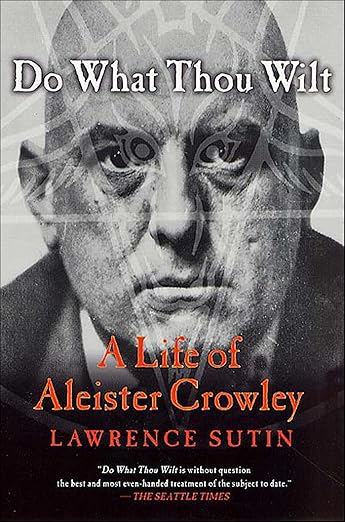
Ironically (or perhaps … not) such echos the central doctrine of Satanism: “Do what thou wilt.” The guiding light of Donald Trump is quite literally the doctrine of Satanism.
In many ways, Hegseth is like the centurion in The Morning Tree, Ras.
He follows an angel of light, who told him to do his will.
He believed the mission was good
But in the end
The infamous angel was evil
With a message of wickedness.
On March 29, 2026, at a Palm Sunday Mass in St. Peter’s Square, in likely response to statements made by leaders such as Pete Hegseth, Pope Leo XIV said:
“Brothers and sisters, this is our God: Jesus, King of Peace, who rejects war, whom no one can use to justify war,” Leo said. “He does not listen to the prayers of those who wage war, but rejects them, saying: ‘Even though you make many prayers, I will not listen: you hands are full of blood.'”
If you still believe that somehow Jesus’ message would have somehow supported war, I would encourage you to read the Sermon on the Mount in the Gospels. If everyone would follow those teaching, then this world would be one of peace and love, without war. This world would be heaven on Earth.
Austin Reams
March 29, 2026
Copyright (c) 2026, Austin Reams, All Rights Reserved.